Edges
This episode premieres on the Delta Psi YouTube channel. The guide sheet is ready now.
DEZ“Someday I build furniture full time.”
WALT“What’s the date on someday?”
The scene
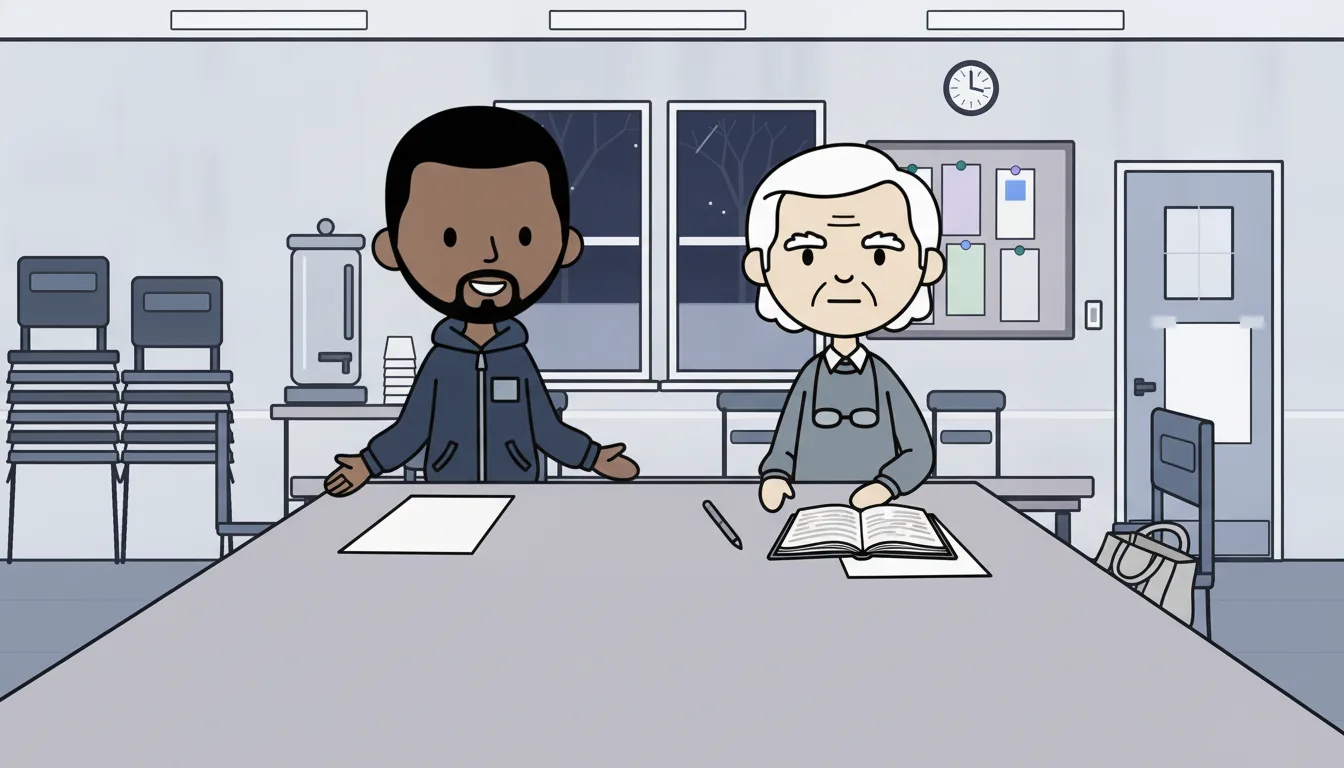
Dez drives a parcel route by day and builds furniture at night in his building’s basement: a workbench, three clamps, a radio. At the Tuesday table, Walt asks him to build the stage from step five, and Dez builds it beautifully: the old tire place on Fourth, big windows, his name on the sign, a bench up front where he teaches on Saturdays. Then Walt asks for the number. Dez would rather not. If he writes a number and misses it, he was wrong, out loud, on paper. Dev says that’s the smartest thing anyone’s said at the table. Dez goes home feeling better than he has in a year, sits on the bottom step with the basement door twelve feet away, scrolls photos of other people’s shops, and goes to bed. The picture was the reward, and he already collected it.
The idea
Everybody wants more money. Ask a room and every hand goes up. Ask the same room how much, by when, and what they intend to give for it, and the hands come down one by one until there are two or three left. Those two or three are the ones who will get it, because they have turned a wish into a goal, and a goal is a different kind of object. A wish is a feeling. A goal has edges.
Wishing is passive. Desire with a plan behind it is a force. The difference is specificity, commitment and action. The steps were written about money first because it is the clearest example. If your aim is a book, a body, a business, a relationship with your kids, substitute it. The mechanics are identical.
Step one. Decide the exact amount. Not “more.” Not “enough.” A number. Then write what the number is for. “A million dollars” is abstract. “Enough to spend August at the lake every year” you can feel on a Tuesday.
Step two. Decide what you will give in return. Nobody gets something for nothing. If you cannot explain why what you are giving is worth the number, the number is a wish.
Step three. Set a date.
Step four. Make a plan, and put the first step somewhere you can start today, ready or not. Write it as a when-then. “I will prospect more” fails. “When I sit down at eight, I will make ten calls before I open email” succeeds, because the situation decides.
Step five. Write out what it will look like and feel like to have it. You are building a stage. Then the correction the old books missed: picturing the outcome by itself tends to reduce effort, because the mind gets a taste of the reward and relaxes. So picture the outcome, then the main obstacle, then what you will do when it shows up. And put yourself in the picture doing the work, not collecting the prize.
Step six. One written statement, in the past tense, as if it has already happened. Under a page.
Step seven. Read it out loud twice a day. Record it on your phone and listen on the drive. Chapter 4 explains why repetition works.
The Memo
- Subject
- Someday
- CC
- One delivery driver. One basement bench. One shop with his name on the sign.
- Moves
- Build the stage, feel the reward, skip the number because a number could be wrong, go to bed happy, the bench stays dark.
- Outcome
- He gets the feeling every night and the shop never.
Someday is tempting because it works, for an evening. The stage is real work and it feels like progress; you can see every board of the shop, and seeing it is pleasant. A number, a date and a first step can all be wrong, and being wrong on paper in front of people is a specific kind of uncomfortable. A wish can’t be wrong. That is what makes it comfortable, and that is why it never gets anything built. Nobody at the table thinks Dez is wrong about the shop. He just hasn’t let it be wrong about anything.
The Rewind
Same Tuesday, same question. This time Walt asks which number Dez would be willing to be wrong about, and Dez writes one, in front of people, in ink: a figure for furniture income by the end of next year, and what it buys him (one weekday off the route, in the shop). Then what he’ll give: twelve commissioned pieces built well enough to put his name on, and a bench he can teach from. Then the date. Then the first step as a when-then: when I get home from the route, before I sit down, I cut one joint. Then the obstacle, which is that nobody has ever paid him for a piece, and the plan for it: the half-built stool gets finished and sells to someone who isn’t his mother by the end of February. Then the statement, past tense, under a page, read into his phone on the bottom step of the stairwell. Across the corner, Dev writes his number and covers it with his hand. He doesn’t have to show anyone. He has to write it.
What it cost: a number he can be wrong about, and one joint cut that night, which came out wrong, and he knows it.
This week
- One
The number, or the outcome, and what it buys. Not more, not enough. A figure, or the exact thing if your aim isn’t money. Under it, what it’s for, in a sentence you could feel on a Tuesday.
- Two
What you’ll give, and why it’s worth the number. Specific enough to convince a stranger. If you can’t, the number is still a wish, and that is useful to know.
- Three
The first step as a when-then, the obstacle and what you’ll do, the date, and the statement, recorded today. One statement, past tense, under a page. Read it into your phone tonight. Two alarms, labeled with the first line.
Go check: the research behind this chapter
The chapter’s “What we know now” section names the people behind each finding so you can go read them. The episode doesn’t name them; this box does.
Specific, difficult goals beat vague ones and beat “do your best”: Edwin Locke and Gary Latham, goal-setting theory, across hundreds of studies.
Implementation intentions (the when-then): Peter Gollwitzer. Plans written as if-then statements get executed because the situation triggers the behavior.
Mental contrasting, packaged as WOOP (Wish, Outcome, Obstacle, Plan): Gabriele Oettingen. Fantasizing about the outcome by itself tends to reduce effort; picturing the obstacle and planning for it fixes that.
Process versus outcome visualization: Lien Pham and Shelley Taylor. Students who pictured themselves studying studied more and scored higher than those who pictured the grade.
Before you watch
Read Chapter 3 before Tuesday, all of it, including the seven exercise steps at the end. Have the book open at step one while you watch. Bring to the table the chief aim you wrote in Chapter 2, rough is fine, and a pen that isn’t a pencil.
Next Tuesday
CARLA: I’m bad with money. Always have been.
Chapter 4 is about the voice in your head, who it belongs to, and how to answer it. Carla has a shoebox, an email from her accountant, and a sentence she has said for twenty years.