The Number of Hours
This episode premieres on the Delta Psi YouTube channel. The guide sheet is ready now.
HAL“Sixty-two. I sell the truck and I’m done.”
WALT“And the Wednesday after that?”
The scene
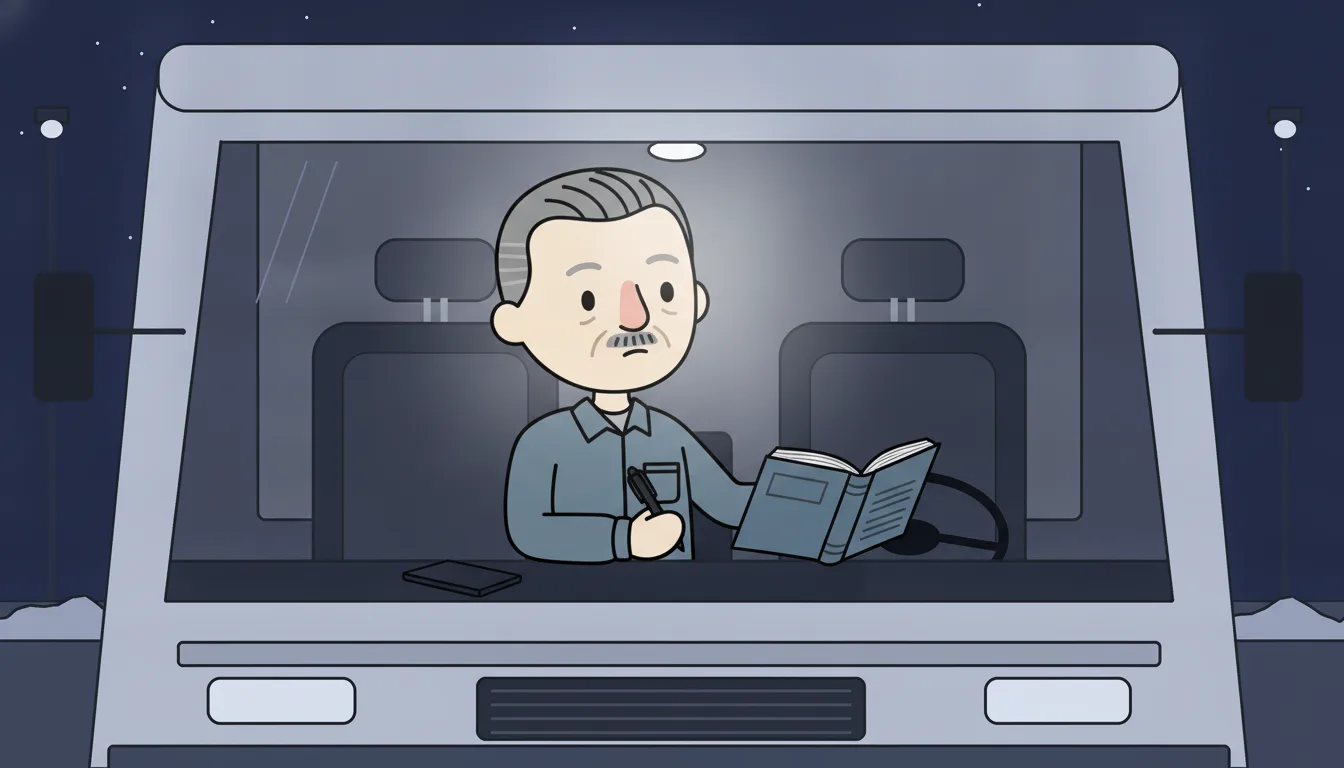
Hal is fifty-eight. Pruitt Plumbing is Hal, a white van with his name on it, and a garage bay behind the house. His plan for twenty years has been sixty-two, sell the truck, done.
Walt asks about the Wednesday after that. Hal has nothing. Fish, he guesses. He does not fish.
Walt asks Carla who first told her “second location.” Carla has owned the salon for eleven years and has never once wanted two of them. Nobody had asked.
Walt gives the table thirty minutes, alone, no phone, and sends them to find a corner of the building.
Hal does the exercise in the van in the parking lot, because he cannot do it at home. He writes one line in thirty minutes, and it is not about fishing.
Carla does it on a chair in the children’s section and cries at a line about apprentices she did not know she would write. She has never trained anyone.
Back at the table, Hal does not unfold his page. “I don’t have a Wednesday.”
The idea
Time is the only thing you spend that you cannot earn back. A dollar lost can be replaced. An hour cannot. Every one of us has a fixed number of them and nobody is told the number.
The book is not saying this to be grim. It is the fastest way it knows to find out what you actually want. Take the number away and people drift. Put the number back and they get clear in about thirty minutes.
Most people borrow a purpose from their parents, their industry, or whoever impressed them at twenty-two, and run on it for decades without checking whether it is theirs. Then something happens, a layoff, a diagnosis, a fiftieth birthday, and the borrowed purpose turns out to have no load-bearing walls.
You need one chief aim. One. A single thing you are building your life toward, stated clearly enough that you could tell a stranger in two sentences.
Desire without an aim is restlessness. Persistence without an aim is stubbornness. A plan without an aim is a to-do list. The people who get what they want are not more disciplined than everyone else as a rule. They have one thing to be disciplined about, and that makes the discipline cheap.
A chief aim does not have to be about money, though it can be. It does have to be yours. Borrowed aims do not survive the first hard year.
What we know now adds one thing: where a goal comes from matters as much as what the goal is. Aims that fit your own values, rather than being imposed by pressure or guilt, get more sustained effort and are reached more often.
The chapter’s tool for finding yours is four lists: what you love, what you are good at, what you can be paid for, and what your corner of the world needs. Where two overlap you get something useful. Where all four overlap you get a life. The lists will not let you ignore the money question, and they will not let you hide behind it.
The Memo
- Subject
- The Borrowed Aim
- CC
- One van. One date. One salon everybody says needs a second one.
- Moves
- Take the plan everybody in your trade says. Run on it for years. Never check whose it is. Reach the date. Find no Wednesday behind it.
- Outcome
- It holds right up until the first hard year.
The pattern is tempting because the borrowed aim comes pre-approved. Everybody in your trade says it, so nobody ever asks you to defend it, and it sounds like a plan every time you say it out loud. It also saves you the thirty minutes. A date is easier to carry than a purpose, right up until you reach the date. The name is for you. Your brother-in-law with the lake house does not need it from you.
The Rewind
Hal writes it, in the van, in block capitals: bring on an apprentice and sell him the business over three years; teach two days a week at the county vo-tech. Then he says it out loud to Bev in the kitchen that night, which is harder than writing it, because he has never told her a plan in his life, only dates. Bev says, “Say it again. Slower.” Carla crosses out “second location” and writes “two apprentices a year who can pay their rent when they leave.” Dev writes “to be rich,” looks at it, and adds a second sentence with a job title and a year in it. No number yet. That is Chapter 3.
What it cost Hal: “done” is gone, replaced by three more years of being Hal and a classroom that scares him more than any crawlspace.
This week
- One
the last day. Thirty minutes, alone, no phone. The end of your life, looking back, in an accounting way. Write what comes. If what comes is one line, one line is what you have got. Do it in the van if you have to.
- Two
the four lists. What you love, what you are good at, what you can be paid for, what your corner of the world needs. Ten items each if you can. Then slide them together and look for what is in the middle.
- Three
your chief aim, in two sentences. Rough is fine. Pencil is fine. You do not have to believe you can reach it yet. You only have to be able to tell a stranger what it is.
Go check: the research behind this chapter
Purpose and survival: Viktor Frankl, a psychiatrist who survived the Nazi camps and built a school of therapy on one observation; the book’s reading list has his Man’s Search for Meaning.
Self-concordant goals: Kennon Sheldon and Andrew Elliot, on aims that fit a person’s own values and interests rather than being imposed by pressure or guilt.
Ikigai: the Japanese word, roughly “a reason to get up in the morning,” and the four-question map the book uses for the four lists.
The last day and the question: the book’s own exercises, from its study groups, no researcher attached.
Before you watch
Read Chapter 2. It is short, and the exercises are most of it. Twenty minutes.
Have the book open and a pen in your hand while you watch. Block out thirty minutes this week, alone, with the phone in another room. You will need them.
Bring to the table: your sentence from last week, and the name of whoever first told you that was the plan.
Next Tuesday
DEZ: “Someday I build furniture full time.”
WALT: “What’s the date on someday?”
Chapter 3 is From Wish to Goal: the seven steps that turn a feeling into a thing with edges, starting with a number.