Where You Point It
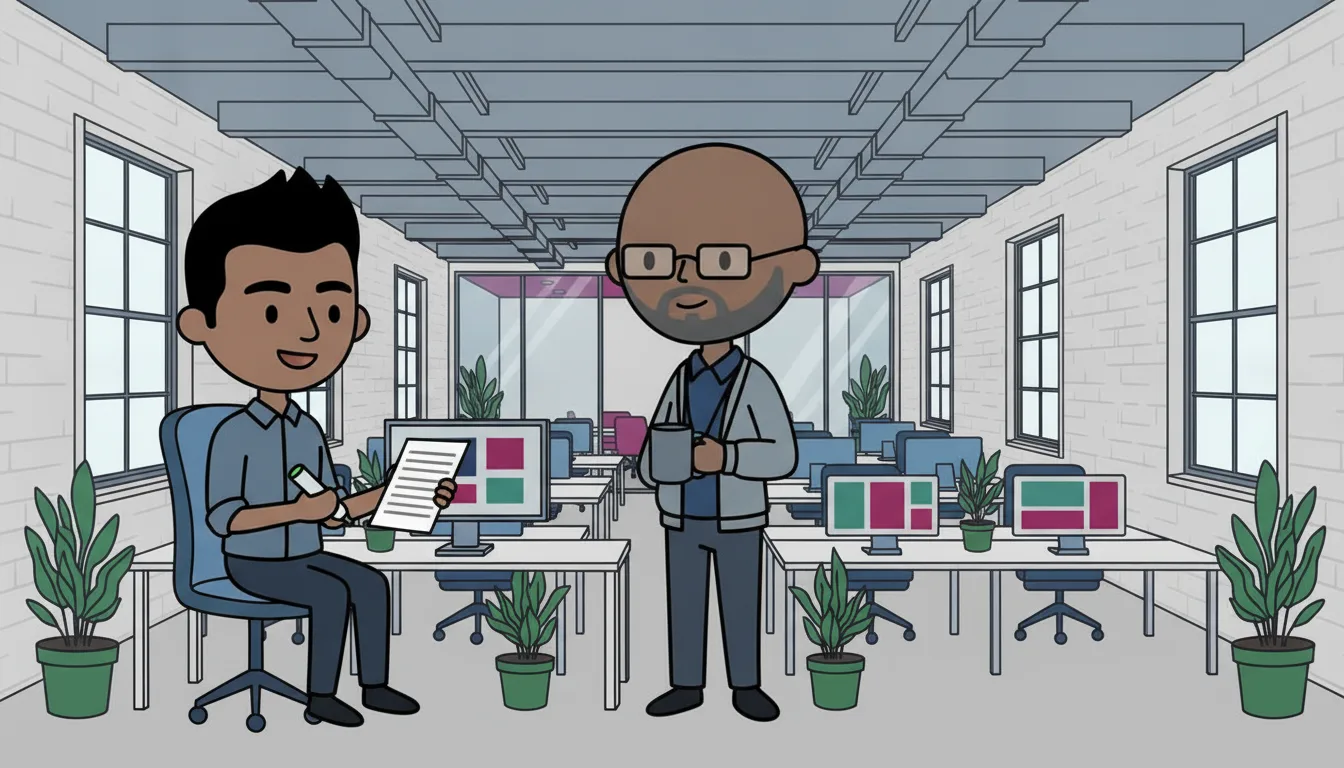
This episode premieres on the Delta Psi YouTube channel. The guide sheet is ready now.
DEV(a list of twelve names) “I can tell you why every name on this list won’t buy.”
RAY“Can you tell me why one of them would?”
The scene
Dev is twenty-six and sells for Ninefold. He has a list of twelve prospects and he can explain, with dates, why nine of them will never buy.
Ray, who runs operations, asks him why one of them would. Dev has no information on that subject.
Ray sends him to a thing on Tuesdays at the public library. Dev goes, twelve minutes late, and keeps his coat on.
Walt, who has kept the Tuesday table for eight winters, asks the table one question: what do you want?
Carla says a second location. Hal says sixty-two, sell the truck, done. Dez says someday, furniture, full time. Dev says: to be rich.
Four answers, five with Dev’s. Not one has a number in it, a date, or a price. Nobody at the table notices.
The idea
Where you point your attention is where you end up. That is the whole of Chapter 1.
Your mind runs on what you feed it. Whatever thought you rehearse most often becomes the lens, and the lens decides what you see. Feed it reasons things cannot work and you will become an expert on obstacles. Feed it a clear picture of what you want and you start noticing doors.
Every sales floor has the man who can tell you, with total authority, why the territory is dead. He is usually right about the details. What he cannot tell you is how anything gets done. He stopped collecting that information a long time ago.
Three patterns show up in almost every story of someone getting what they wanted. They took a risk with no guarantee. They stayed in a humble position until the opening came, through months and sometimes years of work nobody noticed. They did not take no for an answer: not rudely, just steadily. And one pattern shows up in almost every story of failure: quitting a little too soon. Nobody quits at the finish line. They quit a few steps short of it, where it looks exactly like the rest of the road.
Two things make the pointing harder than it sounds. The first is the factory setting: an untended mind drifts toward what is wrong, because bad information weighs more than good. That is not a character flaw. It is the default. The second is the feed. For most of history your dominant thoughts came from the people around you and your own head. Now a large share come from a screen built to keep you looking, and it is tuned to the factory setting. If you have not chosen what you rehearse, something else has chosen it for you.
Before the first chapter, the book lists twelve kinds of wealth. Money is last. Not because it does not matter. Because it is the one most people chase first and find hollow when it arrives alone.
The Memo
- Subject
- The Expert in Obstacles
- CC
- One list of twelve names. One highlighter. One question with no answer.
- Moves
- Study why it fails. Be right about the details. Stop collecting the other kind of information. Call it experience. Put the list back in the drawer.
- Outcome
- He knows the territory is dead. He has never checked.
The pattern is tempting because it is true. The obstacles are real, the reasons are real, and being right about them earns respect from everyone around you. Being right also feels like being done. You can spend a whole career collecting reasons things will not work, be correct about nearly all of them, and never once find out how anything gets done. The name is for you. The person at work who knows why everything fails does not need it from you. Odds are you have been that person.
The Rewind
Same list, next morning. Dev picks the name he had written off hardest and walks in looking for the opening instead of the wall. He does not go in to close. He goes in to find out. He does not close it. What he walks out with is the real reason they left, which nobody at Ninefold knew: three handoffs in one year and a last rep who did not know they had been a customer for six. That is the information he had stopped collecting. And he comes back to the table the next Tuesday.
What it cost: a morning, some pride, and the comfort of being right about Dunmore.
This week
- One
yesterday’s top three thoughts. Recall yesterday from waking to sleep and write the three thoughts you came back to most. No editing. If the top one is a grudge, write the grudge.
- Two
the screen-time report. Open it on your phone. Write the three apps that took the most of your day, and next to each one, what it was feeding you. Say it plainly.
- Three
the hardest pattern. Taking the risk, staying humble until the opening, or refusing no. Which is hardest for you, and why, in one sentence. If the sentence embarrasses you, it is probably the right one.
Go check: the research behind this chapter
Negativity bias: Roy Baumeister and colleagues, “Bad Is Stronger Than Good.”
Frequency illusion: the psychologists’ term for the truck you suddenly see on every road. The book names the term, not a researcher.
The twelve kinds of wealth: the book’s own list, in the front matter, money last.
The feed: the book’s own observation in “What we know now,” no researcher attached.
Before you watch
Read Chapter 1, and the two short pieces before it: “How to use this workbook” and “Twelve kinds of wealth.” Twenty minutes.
Have the book open and a pen in your hand while you watch. The page in the episode is the page in your book.
Bring to the table: one sentence about what you want. Rough is fine. Nobody is grading it.
Next Tuesday
HAL: “Sixty-two. I sell the truck and I’m done.”
WALT: “And the Wednesday after that?”
Chapter 2 is Purpose: the number of hours nobody tells you, the aim you may have borrowed from your trade, and thirty minutes alone with the phone off.