The Long Game
This episode premieres on the Delta Psi YouTube channel. The guide sheet is ready now.
WALT“You’ve all read me your aims. You haven’t heard mine.”
The scene
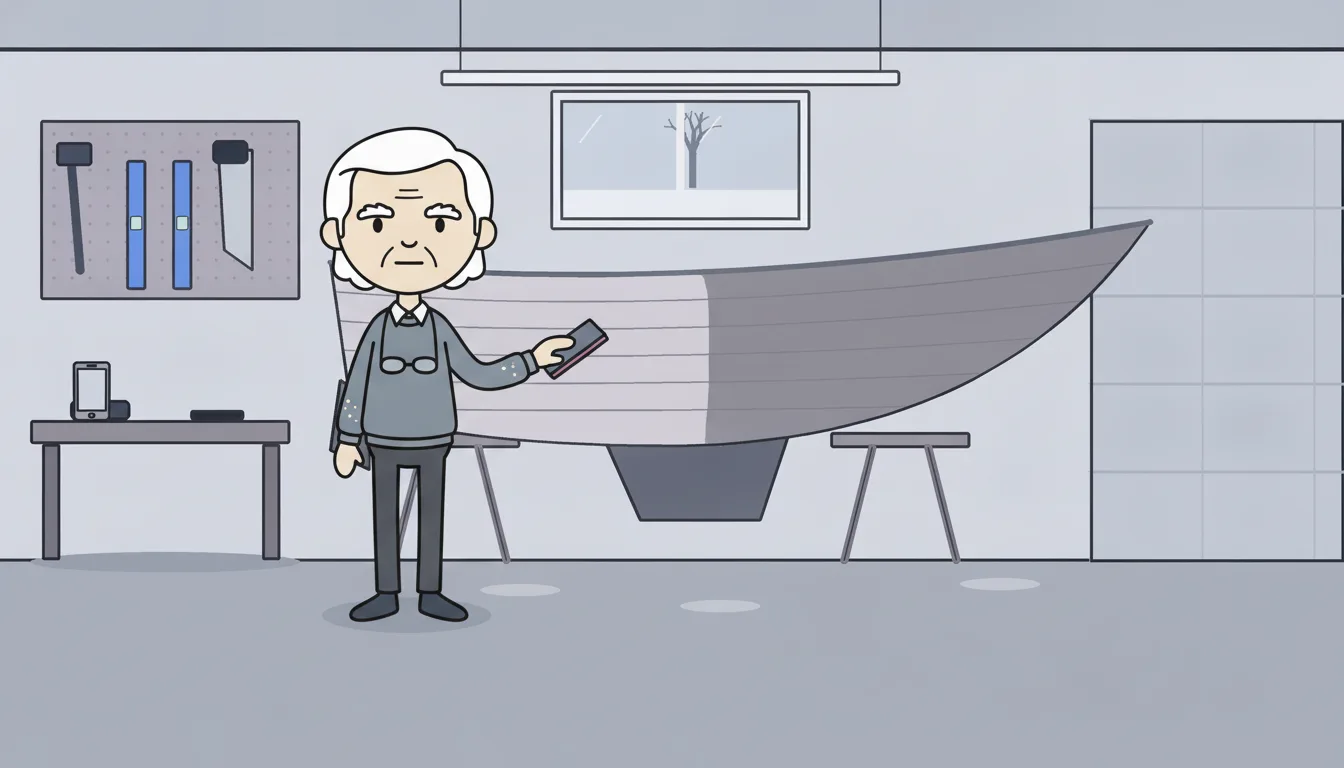
It is the last Tuesday. Walt Kessler, seventy-four, unfolds a page and reads his own aim to the table for the first time: one more table every winter for as long as he is able, and the 1964 sailboat in his garage finished with his grandson before the boy is sixteen. The boy is thirteen.
The table goes through the list of six fears. Carla finds poverty: some weeks there was a paycheck in her house and some weeks there was not, and she still counts the register twice. Hal finds aging; he apologizes to customers for his knees. Dez finds criticism, obviously. Dev says none of them, really, and Walt asks him to read the second one out loud. Dev reads the line about inferiority disguised as bravado and says, “Okay.”
Walt says the last one is his. He would like three more winters, and he would rather not spend them counting.
Dev flips to the back of the book, to the pages of checkboxes, and asks which one he should do first. He wants to be done with this thing. Walt asks about the Tuesday after that.
The idea
You have absolute control over exactly one thing. Not your circumstances, not other people, not outcomes. Your thoughts.
Most of what your mind does, it does without you. Every thought you repeat gets filed deeper. The background mind takes what it is given and works on it, day and night, and it does not care whether what it was given was useful. Feed it fear and it works on fear. Feed it a clear aim, charged with feeling and repeated daily, and it works on that. If you do not deliberately give it something, it will feed on whatever drifts in. A thought with emotion attached gets filed and acted on. A cold thought gets filed and forgotten.
Some of what it files comes back as a hunch: the background mind reporting on patterns it has seen a thousand times and you never counted.
Before any of this can work, three enemies have to be cleared out: indecision, doubt and fear. Indecision becomes doubt, and the two together become fear. Fear hides, and most people who say they fear nothing are simply unaware of their own. There are six basic fears: poverty, criticism, ill health, loss of love, aging and death. Everyone carries some combination.
Worry is fear in slow motion. It is sustained fear caused by indecision, which means it can be ended by decision. You stop worrying about a thing the moment you decide what you are going to do about it, including the decision to accept what cannot be changed.
Beyond the six fears there is a seventh enemy, more often fatal: susceptibility to the negative influence of other people and of your own negative habits of mind. The defense is to use your will until it builds immunity, to seek the company of people who make you think for yourself, and to stop expecting trouble, since trouble rarely disappoints.
None of this is a one-time fix. You are not going to read this workbook and be finished. You are going to use it, and come back to it. The last thing the book asks of you is a schedule.
The Memo
- Subject
- The Alibi
- CC
- One account executive, twenty-six. One book, ten chapters, three inventories in the back.
- Moves
- Ask which one to do first, want to be finished, find the reason it was never going to work anyway, “If I’d started ten years ago,” close the book.
- Outcome
- The book goes on the shelf, finished, and nothing changes.
The pattern is tempting because finishing feels like a grade, and Dev has been good at grades all his life. The alibi is tempting for a different reason: it is a little bit true. He would be further along if he had started at sixteen. Everyone’s alibi is a little bit true, which is what makes the list in the back of the book so long. But excuses do not spend. The world asks only one question: did you do it?
The Rewind
Walt tells Dev there is a sheet on the door. Dev writes his alibi in the margin, “If I’d started ten years ago,” looks at it, and draws one line through it. Then nobody picks which inventory to do first. Each of them writes the one line the chapter puts under the list of fears, the decision that ends the worry. Hal: “I’ll get along on what we’ve got, and I’ll say so to Bev.” Carla: “I’ll get along on what one salon makes. And I’ll know the number, every week, on a spreadsheet.” Dez: “I’ll let them say it. I fix the finish when they’re right, and I leave it when they’re not.” Dev: “I tell one person the number. Out loud. This week.” Walt: “Three winters or thirty. The boat gets built either way.” Each picks this week’s cue, each cuts one feed, and each puts an inventory day on the calendar in the next two weeks, with a date to repeat it. On the way out, four of them sign next winter’s sheet.
What it cost: Dev does not get to be done.
This week
- One
This week’s cue. Pick one: doorways, a faucet, your hands on your face, unlocking your phone. Every time you catch it, stop: what was I thinking, what was the feeling, what was around me. Next week, change it.
- Two
The decision that ends your strongest worry. Find your fear on the list of six and rate it. Then write the decision, one sentence, in ink. Accepting what cannot change counts as a decision.
- Three
Inventory day. Block a day in the next two weeks for the three lists above. Then write the date you will repeat it, and keep the results.
Go check: the research behind this chapter
The book names its sources so you can look them up. The episode does not; this box does.
Two systems: Daniel Kahneman’s description of the mind as a fast, automatic system that runs on pattern and feeling and a slow, effortful one that reasons. The book’s “background mind” is the fast system. Memories with emotional charge are stored differently and more durably.
Sleep and problem-solving: memory consolidation during sleep is well established, as is the finding that people who load a problem before bed are more likely to see the solution in the morning.
When to trust a hunch: Daniel Kahneman and Gary Klein, a joint paper in 2009. Intuition is reliable in environments with real regularities and prompt, clear feedback, after enough practice to learn them. A firefighter’s gut about a building, a chess master’s gut about a position, an experienced salesperson’s gut about a buyer: trustworthy. A gut feeling about the stock market or a stranger’s character: not, because the environment does not teach.
Neuroplasticity: the brain’s ability to rewire itself in response to practice continues through life.
Growth mindset: Carol Dweck’s work on growth versus fixed mindset. Large-scale replications since have found the effect to be real but modest, strongest for people who were struggling.
Negativity bias: Roy Baumeister and colleagues, “Bad Is Stronger Than Good.” The mind over-weights threat by design.
Terror management theory: Jeff Greenberg, Sheldon Solomon and Tom Pyszczynski. Reminders of mortality push people toward their deepest values and commitments, the scientific version of the last-day exercise in Chapter 2.
Worry: decades of work confirming that worry is rumination without a decision attached, and that the most effective treatments all involve converting it into either an action or an acceptance.
Social contagion and the information diet: the Christakis and Fowler findings from Chapter 9 apply directly, and there is a modern channel the old writers never faced. Guarding against negative influence now means deciding what you let onto your screen.
The Stoics, who said two thousand years ago that your thoughts are the one thing you control.
Before you watch
Read Chapter 10 and skim the three lists in the appendix. Do not do the lists yet; they take most of a day, and this guide will have you block that day.
Have the book open to the Fear inventory. Bring your calendar. You will leave with a day on it.
After the last Tuesday
There is no next Tuesday in the book. Walt’s table meets again next January, and there is a sign-up sheet on the door.
Yours meets whenever you call it. The date that matters now is the repeat date you wrote under The schedule: that is the Tuesday after that.