Luggage
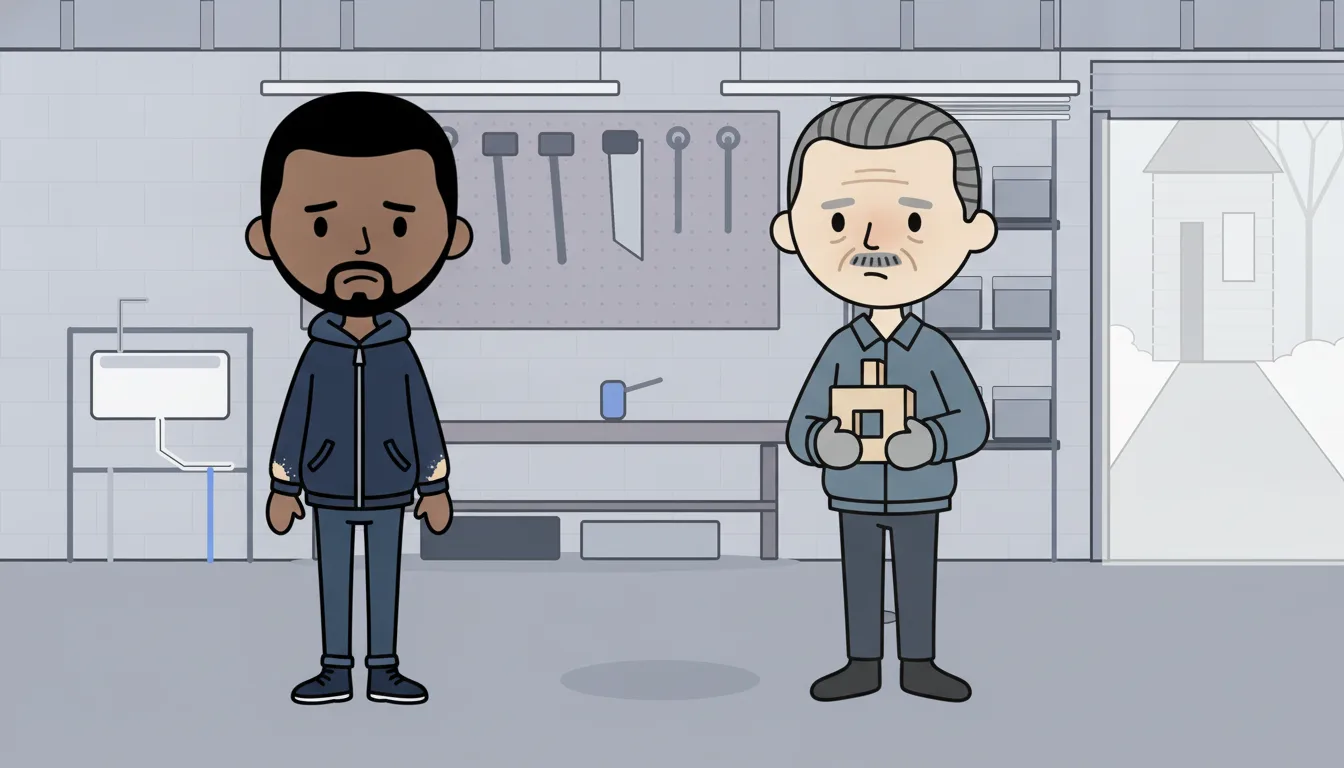
This episode premieres on the Delta Psi YouTube channel. The guide sheet is ready now.
DEZ“I bought the course. Four hundred dollars. Twelve hours of video.”
HAL“Who’s teaching you to cut a joint?”
The scene
Dez drives a parcel route by day and builds furniture in his building’s basement at night. Three weeks ago he wrote a number, a date and a first step: one joint, every night, before he sits down.
Nine days ago he buys a course on the furniture business. Twelve hours of video. He takes notes, eleven pages of them. The chisel does not move.
Across town, Hal has a printout on his bench from the county vocational school: an instructor opening, fall term, two days a week. His aim says he does this. He works around the printout for two weeks, because he has thirty years of knowing how and no idea how to say any of it.
At the table, Walt asks Dez how many joints he has cut since he bought the course. None. He asks Hal how many people he has taught. Hal says it is faster to do it himself.
Carla points out that the two of them are sitting four feet apart. Dez says he will finish the course first, then come by.
The idea
Learning what a fishing pole is and learning how a fishing pole works are two different educations. With the first you collect knowledge. With the second you collect fish.
The book has a picture for people whose education sits on them like a cart of books tied to a donkey. The books do nothing for the donkey except add weight. If what you know does not change what you can do, it is not knowledge. It is luggage.
General knowledge, in any quantity, does not get you to your aim. Organized, specific knowledge, aimed at a definite end through a practical plan, does. Two things about that trip people up. Schooling is not the same as education: the word educate comes from the Latin for “to draw out.” And you do not have to hold the knowledge yourself. You have to know what knowledge your aim requires, and you have to know where to get it. A book, a course, very often a person. Either you have it, or you have a plan to get it, or you have a person who has it. If none of those is true, the aim is still a wish.
One thing has changed this chapter more than any other in the book. Knowledge itself has become almost free. Any fact, any procedure, any summary of any field is a question away, and the answer arrives in seconds, in plain language, from a machine. For most of history the person who knew was valuable because knowing was rare. That advantage is gone. What is left is the how: judgment, taste, knowing which question to ask, knowing when the answer is wrong, knowing how to apply a general answer to your particular customer on your particular Tuesday.
How is built at the edge. The hours that make an expert are hours of practice at the edge of your ability, on a specific weakness, with immediate feedback, uncomfortable by design. Ten thousand hours of comfortable repetition makes you experienced. It does not make you good. If a learning activity is pleasant and smooth, be suspicious of it.
And the oldest finding of all still holds: you learn a thing most thoroughly by teaching it.
The Memo
- Subject
- The Cart of Books
- CC
- One delivery driver. One course. One chisel with dust on it.
- Moves
- Want the skill. Buy the what. Feel it working. Never ask the person who has the how. Call it learning.
- Outcome
- He knows more about the furniture business every week. He still cannot cut a joint.
Why it is tempting: the what is easy to buy and easy to measure. Module seven of twelve is progress you can see. Getting told “wrong” three times in a garage is progress you cannot see, and it costs a Saturday, and it stings. The course is real, the modules are about things Dez will need to know someday, and on a tired night the video feels like work on the aim. That is why the pattern is so comfortable, and why the how column on the page stays empty while the what column overflows. Hal’s version runs the other way: all the how, none of it ever handed on, and a listing on the bench he cannot answer because teaching has never once given him the feedback a leaking joint does.
The Rewind
Dez brings a bad joint to Hal’s garage bay on Saturday instead of finishing the course first. Hal says it is wrong and shows him why, three times: cut to the fit, not the line; watch the left hand, not the saw. The third one seats and will not twist. Hal says, “I didn’t know I knew that.” Before he leaves, Dez writes a ninety-day practice on the back of the vo-tech listing: the weakness (the shoulders do not seat), the edge (one joint a night, tighter than last night’s), the feedback (Saturdays in the bay, a photo on the nights between, Hal says “wrong” out loud), and the uncomfortable part (yes). That night Hal emails the vo-tech about the fall opening and tells Bev he taught a kid on Saturday and the kid got it on the third try.
What it cost: Dez gave up a Saturday and got told “wrong” three times by a man he respects, with the course still paid for and sitting at module seven; Hal gave up a Saturday and sent an email that could come back “no.”
This week
- One
which knowledge your aim needs. List every kind, specifically. Next to each, write have, get, or who has it. Be strict. Having read about it does not count.
- Two
pick one skill and sketch ninety days. One specific weakness, where the edge is, who gives you feedback and when, and the part that will be uncomfortable. If the sketch feels pleasant and smooth, you have written the course. Write the bay.
- Three
explain one thing to one person. Something you learned this month, to someone who does not know it, this week. If you cannot, you do not have it yet. That is useful to know.
Go check: the research behind this chapter
Deliberate practice: Anders Ericsson, who studied expert performers and found that the hours that make an expert are hours at the edge of ability, on a specific weakness, with immediate feedback, uncomfortable by design.
Desirable difficulties: Robert Bjork, a memory researcher, on why rereading feels productive and teaches little, while testing, spacing and mixing feel harder and last.
Knowledge become almost free: the book’s own observation about the last few years, with no single researcher behind it; the premium has moved from holding knowledge to using it.
Learning by teaching: the oldest finding of all, as the book calls it; explain it to someone who does not know it and find out whether you do.
Before you watch
Read Chapter 5 before the episode. It is short, and the exercises at the end are the point.
Have the book open at the exercises, and bring your chief aim from Chapter 2 and your goal from Chapter 3. This week’s page asks what they need that you don’t have yet.
Bring the name of one person who can do the thing you are trying to learn. You will need it.
Next Tuesday
DEV (in the car, a podcast playing): “I had the whole pitch in the shower. Now it’s gone.”
Chapter 6: where ideas come from, why Dev’s left, and what Carla had been looking at every Tuesday for a year.